How fast is 4G compared with 5G? In everyday use, 4G LTE usually delivers about 20–60 Mbps, while 5G typically delivers 100–900 Mbps on the mid-band networks that most carriers now use. The exact numbers depend on the type of 5G, how close you are to the tower, and how busy the network is. This guide compares 4G and 5G speeds, upload, latency and coverage.
4G vs 5G speed at a glance
| 4G LTE | 5G | |
|---|---|---|
| Typical download | 20–60 Mbps | 100–900 Mbps (mid-band) |
| Typical upload | 5–15 Mbps | 10–100 Mbps |
| Typical latency (ping) | 30–60 ms | 15–30 ms |
| Coverage | Almost everywhere | Cities and many towns, growing |
These are typical real-world ranges, not maximums. Results vary a lot from place to place and hour to hour.
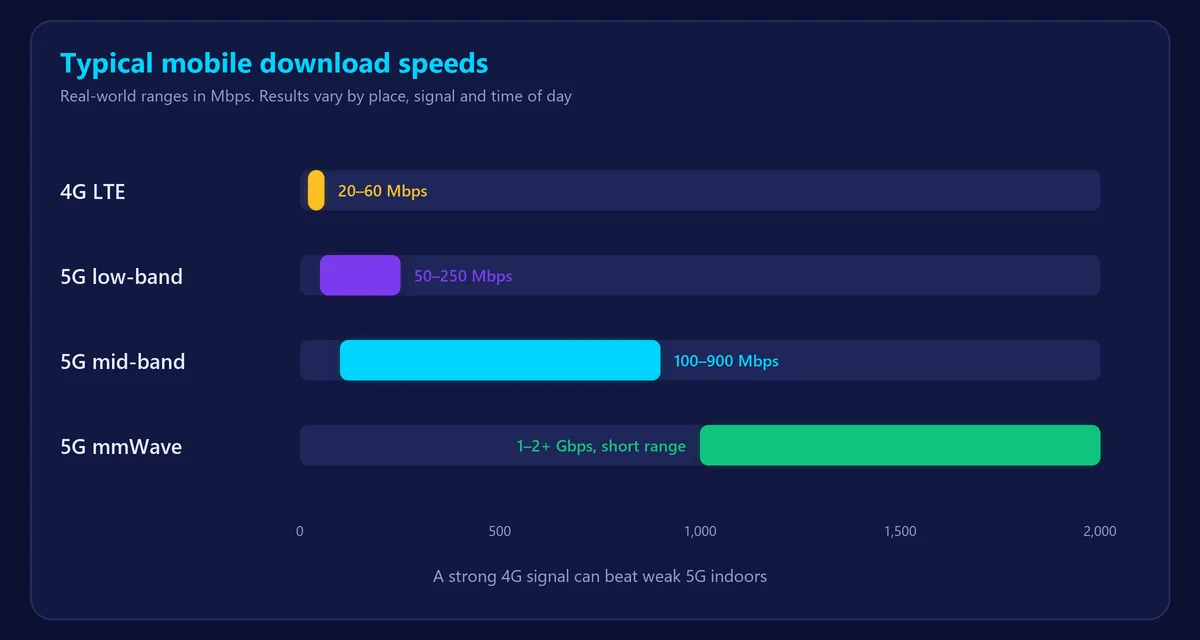
The three kinds of 5G
“5G” covers very different networks, and your speed depends on which one your phone is using:
- Low-band 5G covers long distances, but speeds are often close to good 4G: roughly 50–250 Mbps.
- Mid-band 5G (C-band and 2.5 GHz) is the sweet spot most carriers rely on, with typical speeds of 100–900 Mbps.
- mmWave 5G can exceed 1 Gbps, but only within a short distance of the antenna, usually outdoors in dense areas like stadiums and city centers.
Your phone’s status bar may show 5G, 5G+, 5G UW or 5G UC depending on the carrier; the “plus” labels usually mean mid-band or mmWave.
Is 5G always faster than 4G?
Not always. A crowded 5G cell, a weak signal indoors or a low-band connection can be slower than a strong 4G signal. Your carrier may also slow your data after a monthly limit or during busy times. The only way to know is to measure: run our speed test on mobile data with WiFi turned off, in the same place, once on 4G and once on 5G.
Does 5G have lower ping?
Usually, yes. 5G networks often reach 15–30 ms, while 4G is more often 30–60 ms. For gaming and video calls, lower and more stable ping matters more than raw speed. Check yours with our ping test, and see what is jitter for why stability matters too.
Is 4G fast enough?
For most phone use, yes. Even 10–20 Mbps handles HD video, video calls and social media. 4G only feels slow for large downloads, for 4K video, or when you share it with other devices through a hotspot. See why is my hotspot so slow if that’s your situation.
What about 5G home internet?
5G home internet uses the same mobile network to replace a cable or fiber connection. Typical speeds are often 100–300 Mbps, enough for most households, but they vary with signal and network load. If you use it, see our T-Mobile Home Internet speed test page for tips on placing the gateway.
Frequently asked questions
How fast can 4G go?
Advanced 4G (LTE-Advanced) can reach several hundred Mbps under ideal conditions, but typical real-world speeds are about 20–60 Mbps.
Why does my phone say 5G but feel slow?
You may be on low-band 5G, have a weak signal indoors, or be on a busy cell. Test in another spot or at another time of day.
Does 5G use more data?
5G doesn’t use more data for the same task, but faster speeds can lead apps to load higher-quality video, which uses more.